Social Media

  • BlueSky
  • Facebook
  • Linkedin
  • Instagram
  • English
  • Français

Login/Register

  • Login
  • Register
Home
  • Licensing
    • CRKN Licensing Principles
    • Model License
    • The Banding System
    • 2026 License Negotiations
      • Stakeholder Alignment Group
    • License Negotiations
    • Directories
    • Publishers and Vendors
    • Tools and Services
      • Foreign Exchange Service
      • Perpetual Access Rights Reports (Serials)
  • Open Access
    • Partnership for Open Access
    • Community Open Access Initiatives
    • Read and Publish Agreements
    • APC Discounts
    • Assessment Guidelines for Open Access Publishers
    • SCOAP³
    • CRKN Open Access Journals List
  • Canadiana
    • About the Canadiana Collections
      • Call for Canadiana Collection Development Projects
      • What’s New in the Collections
      • Navigating the Collections
      • System Status
      • Canadiana Citation Guide
      • Canadiana Infrastructure Updates
      • Canadiana Metadata and Usage Reports
      • Rights Statement Project
      • History of Canadiana
    • Digitization Services
      • Digitization Projects
    • Preservation and Access
      • Trustworthy Digital Repository
    • Digital Heritage Content and Preservation Listserv
    • Acquisition and Use of Commercial Microfilm
    • Future of Canadiana
  • Persistent Identifiers
    • ORCID-CA Consortium
      • How to Join ORCID-CA
      • ORCID-CA Governing Committee
    • DataCite Canada Consortium
      • How to Join DataCite Canada
      • DataCite Canada Governing Committee
    • National PID Strategy
    • Canadian Persistent Identifier Advisory Committee
  • Collaborations
    • Coalition for Canadian Digital Heritage
    • HSS Digital Research Infrastructure in Canada
  • News
    • CRKN Updates
    • Knowledge Exchange
    • Reports
  • Events
    • 2026 CRKN Virtual Conference
    • 2025 CRKN Member Summit and AGM
    • External Events
    • Webinars
    • Code of Conduct
    • Webinar Recordings
  • About
    • Members
      • Associate Membership
    • Board of Directors
    • Committees
      • Executive Committee
      • Finance and Audit Committee
      • Content Strategy Committee
      • Preservation and Access Committee
        • Canadiana Content Sub-Committee
        • Platform Technical Sub-Committee
      • Conference Planning Committee
      • Task Groups
      • CRKN Researcher Council
    • Annual Report
    • Staff
    • Careers
    • History of CRKN
    • Ron MacDonald Service Award
    • Strategic Plan
Menu

When Writers Fall in Love: Infamous Romantic Era Couples Who Changed Literature

Blog

February 13, 2026
Knowledge Exchange blog banner

By: Mélanie Plante, Communications Coordinator

https://doi.org/10.82389/nasx-7w14 

This Valentine’s Day, we’re celebrating love stories that shaped literary history with the help of open access research.

We're highlighting two fascinating couples from the Romantic era: Mary Wollstonecraft and William Godwin, and their daughter Mary Shelley and her husband Percy Bysshe Shelley. These weren't just romances; they were creative partnerships that produced some of history's most influential books and ideas. Think of them as the original power couples.

Thanks to free, open access articles supported by the Partnership for Open Access (POA), you can explore these relationships for yourself. No subscription nor paywalls here, just passionate debates about grammar and poetry. What better way to explore love and partnerships than through the Partnership for Open Access!


Mary Wollstonecraft and William Godwin: When Reason Met Passion
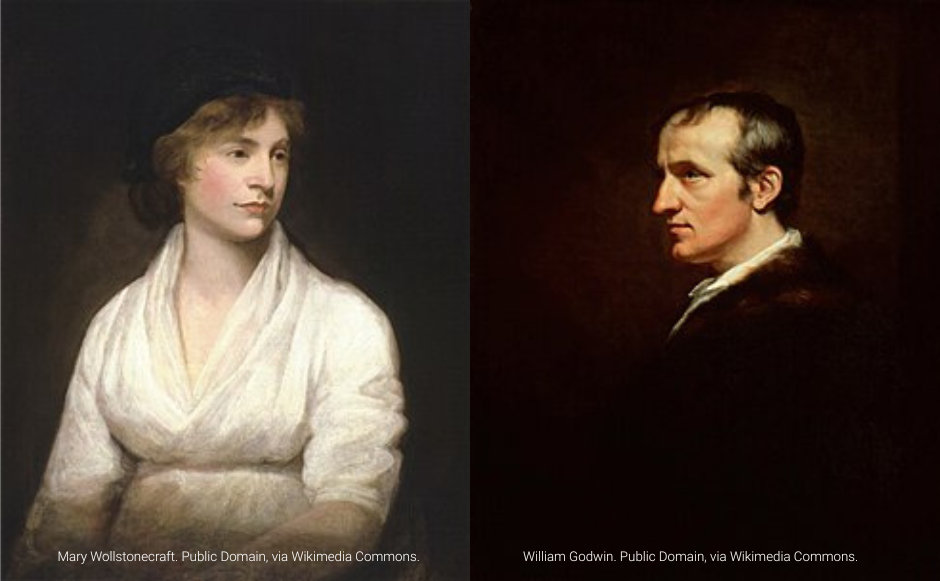
Mary Wollstonecraft and William Godwin

Mary Wollstonecraft, author of the groundbreaking A Vindication of the Rights of Woman, was a pioneering feminist philosopher. Her husband, William Godwin, was a political thinker and novelist who believed logic and reason could fix society's problems.

They met in 1796, and on paper, they seemed like a terrible match with completely different values. However, they challenged each other, loved each other, and treated each other as intellectual equals.

Sadly, their relationship lasted barely a year. Wollstonecraft died in September 1797, just days after giving birth to their daughter Mary (yes, that Mary — the one who wrote Frankenstein).

In the article “Can a statue breathe? The Linguistic (un)coupling of Godwin and Wollstonecraft,” scholar Jane Hodson digs into how Wollstonecraft and Godwin embodied one of the Romantic era’s central tensions: the conflict between reason and feeling, especially in their theories about language and writing style.

Godwin valued clear communication and perfect grammar above all, while Wollstonecraft valued genuine feeling and eloquence, writing that comes straight from the heart, even if that meant there were grammatical errors.

Their letters show they argued about this a lot. In September 1796, Wollstonecraft fired back at Godwin after he criticized how she wrote, saying essentially: My messy, passionate writing beats your perfectly polished prose any day.

A few days later, though, she was joking around with him again, agreeing to grammar lessons. Even their fights had a flirty edge.

Here's the twist: Twenty-five years after Wollstonecraft died, Godwin went back and completely rewrote his essay about what constitutes good writing. He took back almost everything he'd said before and started praising exactly the kind of emotional, spontaneous writing Wollstonecraft had championed all along. Wollstonecraft, wherever she was, must have been saying "I told you so." 

Read the full article: “Can a statue breathe? The Linguistic (un)coupling of Godwin and Wollstonecraft” (Free to access)


Mary and Percy Shelley: A Partnership Under Scrutiny
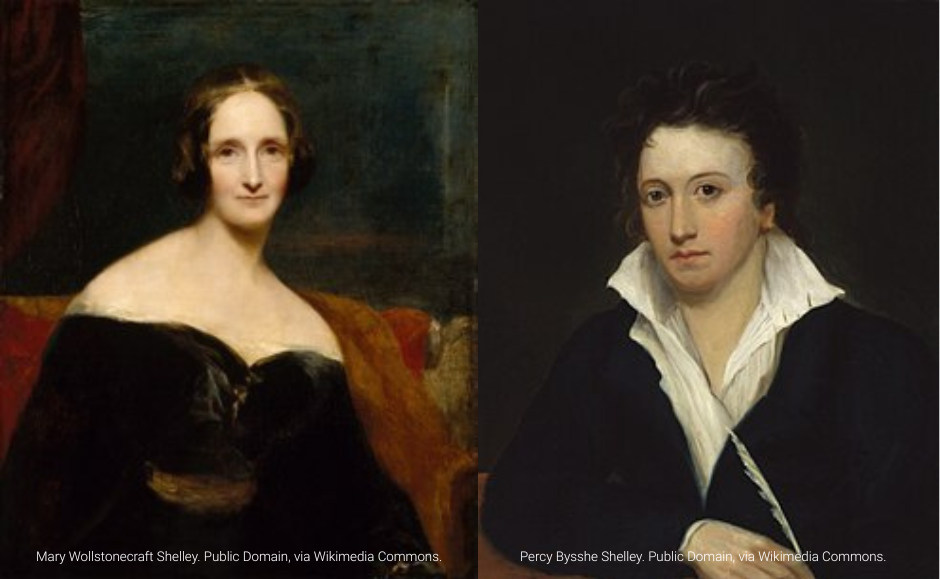
Mary Wollstonecraft Shelley and Percy Bysshe Shelley

The next generation created their own legendary partnership: Mary Shelley (daughter of Wollstonecraft and Godwin), wrote Frankenstein, one of literature's most enduring novels, at just nineteen. Her partner, Percy Bysshe Shelley, was one of the most famous Romantic poets of his time and a serious rule-breaker.

Growing up, Mary heard all about her parents' romantic and intellectual partnership. So when she fell for Percy in 1814, Mary eloped with him at just sixteen.

Their relationship went down in history for its creative collaboration, shared idealism, and defiance of social conventions. They wrote side by side nightly, creating some of the era's most important literary works.

Their life together wasn't easy, though. They were always short on money, living in exile from England, rumours following them wherever they went, and dealing with heartbreaking losses (three of their children died young). Plus, they were friends with controversial people like Lord Byron, which fueled even more gossip. The question everyone's been asking for 200 years: were they equal creative partners, or did one dominate the other? Nora Crook tackles this question head-on in the article “Pecksie and the Elf: Did the Shelleys Couple Romantically?” by looking at the actual evidence instead of repeating old rumors. She finds that most fall into three camps, each with its own devoted fans.

In the first, Percy was the victim of Mary's coldness and ingratitude. In the second, Mary suffered under Percy's domineering, unfaithful behavior. Crook champions the third: what she calls the "Nice version", they respected each other and worked as creative equals.

Evidence shows a healthy intellectual and romantic relationship. The two had cute pet names for one another, with Percy calling Mary “pretty Pecksie” in the notes of the Frankenstein manuscript and Mary calling Percy her “sweet Elf”. They were both involved in editing and publishing each other’s greatest works. Their values also completely align with them both valuing above all intense experiences of connection with each other, nature, or art.

Crook ends her article by saying while we know a lot about the Shelleys, we're also missing huge pieces of the puzzle. What we can say for sure is that they both saw love as something that could transform you, and they genuinely worked together as intellectual partners throughout their relationship. 

Read the full article: "Pecksie and the Elf: Did the Shelleys Couple Romantically?" (Free to access)


Two Generations, One Question: What Makes a Partnership?

From parents to daughter: both couples navigated the tension between love and partnership, reason and feeling, collaboration and independence.

The common thread was that all four valued intense connection: intellectual, emotional, creative connection.

Both couples changed the world, broke the rules, and made us reconsider everything from women's rights to the ethics of reanimating corpses. Not bad for a family tree. 

The Democratization of Knowledge Through Open Access Initiatives

Modern scholarship allows us to challenge long-held assumptions with fresh evidence and careful textual analysis. Open access publishing ensures everyone can engage with these scholarly debates, not just those with university library access.

These articles are available on Érudit and supported by the POA, a collaboration between CRKN and Érudit that provides financial support to non-commercial scholarly journals promoting open access publishing in Canada.

CRKN's commitment to open scholarship means readers can form their own opinions by engaging directly with the research. When diverse voices join the conversation, new perspectives emerge. Because the best discussions happen when everyone gets a seat at the table. 

Browse the full collection of open access journals covered by CRKN agreements and discover what other treasures await in our collections. Who knows? You might find your next favorite literary debate.

Melanie Plante Headshot


Mélanie Plante (https://orcid.org/0009-0000-5563-3743)

Mélanie holds an Honours BA in English from the University of Ottawa. She joined CRKN in February 2024 and is passionate about Canadian literature.

Related Links

Science Dimension (1969–1984): Seeking Evidence of Women in STEM
Women in Science Dimension: Hidden Histories Revealed During the Fall 2025 term, Olivia Georgiou, Queen’s University undergraduate student in Political Science and History, joined CRKN staff members Percy Miller, Heritage Services Specialist, and Angela J
Enhancing IIIF Content Structure with Range Editing
This article, covering Digirati and CRKN's collaborative work to develop range editing capabilities for the Digirati IIIF Manifest Editor, was originally published on Medium on December 2, 2025. CRKN uses IIIF standards and the Digirati Manifest Editor, a
Researching Military History in the Canadiana Collections
November 11 is a day when many of us begin thinking about Canada’s military history, whether we have veterans close to us, or we want to better understand how war has shaped our past. With millions of pages of digitized historical documents, the Canadia
crkn footer logo

Canadian Research Knowledge Network

1309 Carling Ave PO Box 35155 Westgate Ottawa, ON K1Z 1A2 t. 613.907.7040

Footer menu

  • Contact Us
  • Newsletter Sign Up
canadiana-footer-logo

CRKN respectfully acknowledges that its offices are located on the traditional, unceded territory of the Algonquin Anishinaabe People. We also recognize that our member institutions are situated across the land now known as Canada, and we extend our respect and gratitude to all First Nations, Métis, and Inuit communities.

Through our work—particularly with the Canadiana and Héritage collections—we are committed to acknowledging colonial injustices, supporting First Nation, Inuit, and Métis data sovereignty, and working in partnership with communities. We strive to engage in respectful practices that honour community protocols and uphold the right of Indigenous Peoples to determine how materials related to their heritage are governed.

Policy Menu

  • Privacy Policy
  • Accessibility Policy
  • Sitemap
© 2013 - 2026 Canadian Research Knowledge Network
  • Licensing
    • CRKN Licensing Principles
    • Model License
    • The Banding System
    • 2026 License Negotiations
      • Stakeholder Alignment Group
    • License Negotiations
    • Directories
    • Publishers and Vendors
    • Tools and Services
      • Foreign Exchange Service
      • Perpetual Access Rights Reports (Serials)
  • Open Access
    • Partnership for Open Access
    • Community Open Access Initiatives
    • Read and Publish Agreements
    • APC Discounts
    • Assessment Guidelines for Open Access Publishers
    • SCOAP³
    • CRKN Open Access Journals List
  • Canadiana
    • About the Canadiana Collections
      • Call for Canadiana Collection Development Projects
      • What’s New in the Collections
      • Navigating the Collections
      • System Status
      • Canadiana Citation Guide
      • Canadiana Infrastructure Updates
      • Canadiana Metadata and Usage Reports
      • Rights Statement Project
      • History of Canadiana
    • Digitization Services
      • Digitization Projects
    • Preservation and Access
      • Trustworthy Digital Repository
    • Digital Heritage Content and Preservation Listserv
    • Acquisition and Use of Commercial Microfilm
    • Future of Canadiana
  • Persistent Identifiers
    • ORCID-CA Consortium
      • How to Join ORCID-CA
      • ORCID-CA Governing Committee
    • DataCite Canada Consortium
      • How to Join DataCite Canada
      • DataCite Canada Governing Committee
    • National PID Strategy
    • Canadian Persistent Identifier Advisory Committee
  • Collaborations
    • Coalition for Canadian Digital Heritage
    • HSS Digital Research Infrastructure in Canada
  • News
    • CRKN Updates
    • Knowledge Exchange
    • Reports
  • Events
    • 2026 CRKN Virtual Conference
    • 2025 CRKN Member Summit and AGM
    • External Events
    • Webinars
    • Code of Conduct
    • Webinar Recordings
  • About
    • Members
      • Associate Membership
    • Board of Directors
    • Committees
      • Executive Committee
      • Finance and Audit Committee
      • Content Strategy Committee
        • Knowledge Base Entitlements Sub-Committee
      • Preservation and Access Committee
        • Canadiana Content Sub-Committee
        • Platform Technical Sub-Committee
      • Conference Planning Committee
      • Task Groups
      • CRKN Researcher Council
    • Annual Report
    • Staff
    • Careers
    • History of CRKN
    • Ron MacDonald Service Award
    • Strategic Plan